


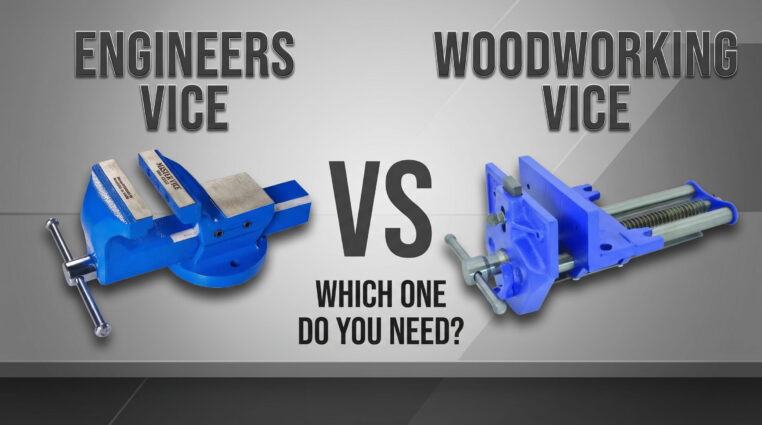
An engineers vice grips metal with hardened, serrated steel jaws and takes the force of filing, sawing and hammering. A woodworking vice holds timber between smooth, usually wood-lined jaws that leave the surface unmarked. The choice between an engineers vice and a woodworking vice depends on the material you hold and the force you put through it. How the vice is fixed then decides whether the bench can carry that force.
For sizing a vice to the job and building a bench around it, see our guide to choosing the right workbench and vice setup.
How an Engineers Vice and a Woodworking Vice Differ
Jaw faces and what they hold
The jaws of an engineers vice are hardened steel with serrated faces. The teeth bite into metal, so a bar or section stays put while it is filed, sawn or drilled. On timber or finished metal the same teeth leave marks. Benchmaster’s engineering vices have precision-machined jaws and a fixed base. Across the category, jaw faces are often separate plates that can be replaced when they wear.
A woodworking vice has smooth jaw faces, usually lined with timber or a similar soft material. The lining spreads the pressure across the workpiece and keeps edges and faces clean. Woodworking vices also tend to be wider across the jaws than engineers vices, because the timber they hold is often larger. Benchmaster’s Woodworking Vice is made from grey cast iron, and the quick release model has location holes for fitting your own wooden cheeks.
Jaw width and opening
Vice size is given as jaw width, the measurement across the jaws. A 100mm vice has jaws 100mm wide. The opening is how far the jaws part, and it limits the thickest piece the vice can hold.
Benchmaster’s engineering vices come in four jaw widths. They are 4 inch (100mm), 5 inch (125mm), 6 inch (150mm) and 8 inch (200mm). The Woodworking Vice comes in two jaw widths. The 7 inch (175mm) vice opens to 8 inches (200mm), and the 9 inch (225mm) vice opens to 13 inches (325mm).
To choose between the two woodworking sizes, start with the largest piece the vice will hold. The opening has to clear its thickness, and a wider jaw gives more grip along an edge, so the 9 inch vice suits larger timber and the 7 inch vice suits smaller work. For engineering vices, matching the width to the work and to the strength of the bench is covered in our setup guide.
Plain screw or quick release
The Woodworking Vice comes in two versions. On a plain screw vice, the moving jaw travels the full length of the screw, so opening and closing is done by winding the handle. It suits a bench where the workpieces are similar in size. The nut is housed beneath the body, which keeps the screw aligned and reduces wear.
A quick release vice can be opened and closed without turning the main screw. The moving jaw slides straight to the workpiece, and the screw is used only for the final tightening. It suits a bench where pieces change often, such as a training bench that sees a different job every session.
Both versions have steel guide rods that keep the jaws parallel, and an adjustable front stop that adds clamping options.
Choosing the Right Vice for the Work You Do
Mostly metalwork
Choose an engineers vice. Filing or sawing a steel section pushes sideways and backwards on the jaws, while hammering sends shock through the base and into the fixing. Serrated, hardened jaws keep the work from shifting under that load.
Mostly timber
Choose a woodworking vice. Boards held on edge or on their face need smooth jaws that do not bruise the surface, and a wood lining that can be replaced when it is marked. School and training workshops that teach woodwork are a natural fit for a woodworking vice.
A mix of both
There are two sound options, each with a trade-off.
- Soft jaw faces on an engineers vice: magnetic or bolt-on soft jaws let one vice hold timber, finished parts or softer metal without marking. The trade-off is a narrower jaw than a woodworking vice offers, so large timber is awkward to hold.
- A vice of each type: each vice does the job it was built for. The trade-off is a second fixing and the bench length it takes up.
If metal and timber are both daily work, separate benches keep filings and swarf out of timber work.
How to Fit a Vice So the Bench Takes the Load
Every vice passes the force of the work through its fixing, into the top, and down into the frame. A vice that is well chosen but poorly fixed loosens over time and wears the top around the bolts.
What the top and the frame need to provide
The top has to be thick and rigid enough to take the bolts and the leverage of the vice without flexing. On a steel top, the holes are drilled to the pattern of the vice base. On a timber top, a reinforcing plate under the fixing stops the bolt heads pulling into the grain. Fixing a vice over an unsupported part of the top flexes it with every tightening.
Bracing in the frame beneath the vice area is covered in our setup guide. For where along the bench the vice should go, see our guide to where to put a vice on a workbench.
Fixing an engineers vice
An engineers vice is through-bolted using the fixing holes in its base, with nuts and washers beneath the top. When a vice is ordered with a Heavy Duty, Super Heavy Duty or Mobile Workbench, Benchmaster drills the vice-fixing holes in the top. A Heavy Duty Workbench also has a vice plate welded under the front right-hand corner. A swivel base is available for each vice, with 360-degree rotation, for work that needs the vice turned towards the user.
Check the fixings regularly. Hammering and leverage work bolts loose over time, and a loose vice moves under load before the bench does.
Fixing a woodworking vice
A woodworking vice is fixed from underneath the top, with spacer blocks set behind it so the jaws sit at the right depth relative to the bench surface. Benchmaster’s Woodworking Vice mounts onto Heavy Duty and Super Heavy Duty Workbenches.
The rear jaw can be set flush with the front edge of the bench or left proud of it. Flush mounting lets you clamp long boards against the front of the bench and plane an edge along its full length. A proud fixing is quicker to fit, but the vice then sits in the working area. The wood lining should sit slightly below the top surface so it does not catch tools passing over it.
Bench mass and anchoring
The leverage of a long workpiece in a vice can rock a light bench or walk it across the floor. The heavier the bench, the less it moves, and a bench bolted to the floor is steadier still.
Load capacity is a separate measure from bench mass. Benchmaster’s Heavy Duty Workbench supports up to 1,000kg uniformly distributed load (UDL), and the Super Heavy Duty Workbench up to 1,500kg. A UDL rating describes weight spread evenly across the top, so it shows the strength of the structure rather than how well a bench resists the sideways leverage of a vice.
Each Mobile Workbench is fitted with a vice plate, so a vice can be added to it. It needs more care than a fixed bench, because castors let it move under the same leverage. The castors lock, and they should be locked before any work is done at the vice.
Specifying the Bench and Vice Together
Every Benchmaster bench is built to order, so the bench and vice can be specified at the same time. The vice size, the worktop and the fixing holes are decided together, and the fixing holes are drilled in the top when the vice is ordered with the bench. The Workbench with Vice range is fully welded and made for workshops and industrial facilities.
Vices can also be ordered on their own. See the range of engineering vices and bases and the Woodworking Vice. The load ratings quoted above are listed on the Heavy Duty Workbench and Super Heavy Duty Workbench pages. For advice on vice size, top material or fixings for a specific bench, get in touch.
- Blog
More like this
Electric vs Manual Height Adjustable Workbenches: How to Choose
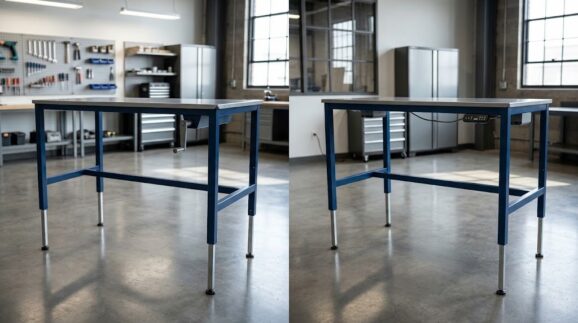
Electric and manual height adjustable workbenches from Benchmaster are both hydraulic and built on the medium duty range. The difference is how the hydraulic pump is driven. The electric version uses a motor unit and a push button, and the manual version uses a removable hand crank. Both are available at 300kg or 600kg UDL, […]
View Case Study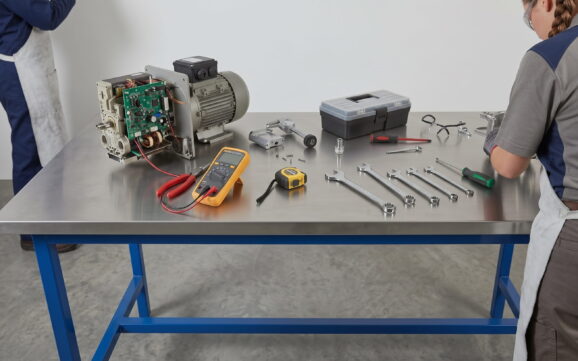
Workbench Worktop Materials Compared: Which One Do You Need?
The worktop is the part of a workbench that actually does the work. The frame holds it up and the accessories organise around it, but every spill, impact, static charge, and hour of use happens at the surface itself. Choosing the wrong one is not a small mistake. It is the difference between a bench […]
View Case Study
Choosing a Lab Bench for Microscopy and Vibration-Sensitive Work
A microscope does not care whether the vibration reaching it came from the floor, from footsteps in the corridor, or from an air handling unit two rooms away. It only registers the movement. At high magnification, movement that would be completely unnoticeable to a person standing at the bench is enough to blur an image […]
View Case Study