


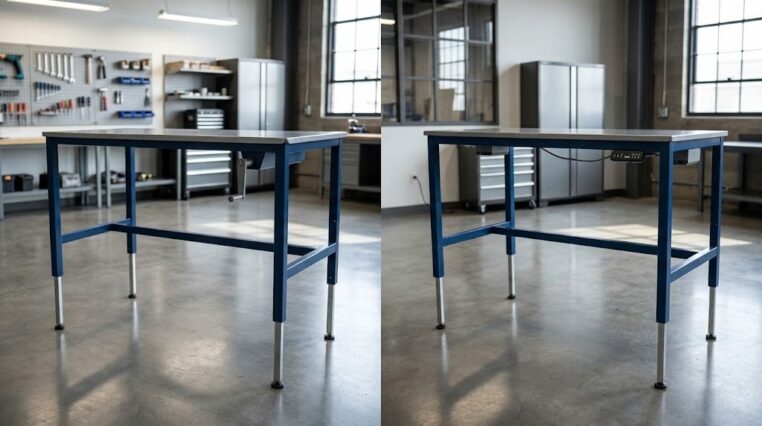
Electric and manual height adjustable workbenches from Benchmaster are both hydraulic and built on the medium duty range. The difference is how the hydraulic pump is driven. The electric version uses a motor unit and a push button, and the manual version uses a removable hand crank. Both are available at 300kg or 600kg UDL, and both adjust over the same 300mm range. When choosing a height adjustable workbench, the choice comes down to how often the height changes, how many people share the bench and whether there is a power supply nearby.
- Choose electric if the height changes often, several people share the bench and a socket is within reach.
- Choose manual if the height is set and left, one person uses the bench, or there is no power nearby.
For guidance on setting a bench to suit the person using it, see our guide to ergonomic height for workbenches.
How Electric and Manual Height Adjustable Workbenches Work
A hydraulic system uses a pump to raise and lower the top. The two versions differ in what drives that pump.
Electric hydraulic
On the electric height adjustable workbench, a motor unit drives the hydraulic pump, so the height is changed electrically rather than by hand. A push button mounted in front of the worktop controls it, and the bench runs from a 13A UK plug. The bench moves through its 300mm range in seconds, depending on the load, and it can be adjusted with a load on the top, provided the load is within the 300kg or 600kg rating of the mechanism. The bench arrives ready assembled.
Manual hydraulic
On the manual version, the hydraulic pump is worked by a removable hand crank. There is no motor and no power supply to arrange. The height is changed by turning the crank, which takes more effort and time than the electric version but keeps the bench free of any electrical connection.
What Both Options Share: Load and Adjustment Range
Load and range do not separate the two options, so they can be settled first. Both are available at 300kg or 600kg UDL. UDL stands for uniformly distributed load, the weight a bench carries when it is spread evenly across the top. Our guide to workbench weight capacity explains how to read the figure. Choose the rating from the heaviest load the bench will carry, and choose the adjustment method separately.
The adjustment range is 300mm, from 700mm to 1000mm. Check that range against the shortest and tallest people who will use the bench and the height each task needs. Our ergonomic height guide covers how to find the right height for a user. If the range does not cover everyone who will use the bench, speak to us before ordering.
Choosing Between Electric and Manual
How often the height changes
A bench that is adjusted several times a day, between tasks or between users, calls for the electric version. The motor and push button remove the effort and the pause that come with winding a crank each time.
A bench set to one height for a task or a person and left there fits the manual version. The crank is used rarely, so the extra cost of a motor brings little.
How many people share the bench
Where people of different heights share a bench, the height is adjusted at every changeover. Electric makes each change quick. Where one person uses the bench, or a group works at the same height, manual is usually enough.Power and position
The electric version runs from a 13A UK plug, so the bench has to sit within reach of a socket, with a safe route for the cable. The manual version needs no power and can go wherever the layout works best. If the position of the bench is not yet fixed, that favours manual.
Cost, upkeep and warranty
The electric version costs more to buy than the equivalent manual version, because it adds a motor unit. Weigh that against the time saved at each adjustment. For a bench adjusted often, the time saved adds up across the working day. For one adjusted rarely, it adds little.
Both versions carry a 2-year warranty, and the mechanisms are designed to be maintenance free. A service kit can be supplied for owners who want to service the mechanism themselves, but it is generally not needed.
Which Option Suits Which Workshop
Benchmaster’s height adjustable workbenches are used across a range of industries and workspaces. The same question applies in each, which is how often the height changes and who changes it.
– Packing and distribution: raising and lowering the bench lets goods be placed at working height without lifting them, which improves safety. Electric is the better match for a packing or handling bench adjusted through the shift.
– Schools and universities: height differences between students are the main reason to specify adjustment at all. Where several students share a bench in a session, electric changes the height quickly between users. Where a bench is set for a group and changed between lessons, manual is enough.
– Automotive production: work moves between tasks and components of different sizes, and each may call for a different height. Electric fits a bench that changes task often, and manual is the better match for one dedicated to a single operation.
– Assembly and production lines: benches shared across shifts are used by people of different heights. Electric makes each handover quick. A bench with one regular operator and a fixed task works well with manual.
– Home workshops: workshops vary in shape and space, and raising or lowering a bench makes better use of both. A single user who adjusts occasionally is well served by manual, and it needs no socket.
– Workshops with limited space: one adjustable bench can serve work that would otherwise need separate benches at different heights. That saves floor space with either option.
– Food production: a stainless steel worktop is available on the height adjustable range, alongside the other surfaces. The adjustment method follows the same question of how often and by whom the height is changed.
Specifying a Height Adjustable Workbench
Every Benchmaster bench is built to order, so the adjustment method, load rating, worktop, size and colour are chosen together. Worktops include MDF, compact laminate, galvanised steel (stainless steel is available), ESD, laminate, and black rubber on steel. MDF, laminate and ESD worktops overlap the frame by 10mm on all sides. Benches are available from 1200mm to 2000mm wide and 600mm to 1200mm deep, in nine frame colours, with other sizes and bespoke options on request. Our guide to workbench worktop materials explains how to choose between the surfaces.
See the full height adjustable workbenches range, or go straight to one of the four hydraulic benches.
– 300kg Electric Hydraulic Height Adjustable Workbenches
– 600kg Electric Hydraulic Height Adjustable Workbenches
– 300kg Manual Hydraulic Height Adjustable Workbenches
– 600kg Manual Hydraulic Height Adjustable Workbenches
For help choosing an adjustment option for a specific bench, get in touch.
- Blog
More like this
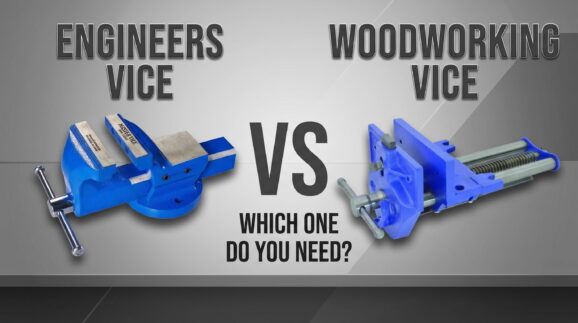
Engineers Vice vs Woodworking Vice: How to Choose
An engineers vice grips metal with hardened, serrated steel jaws and takes the force of filing, sawing and hammering. A woodworking vice holds timber between smooth, usually wood-lined jaws that leave the surface unmarked. The choice between an engineers vice and a woodworking vice depends on the material you hold and the force you put […]
View Case Study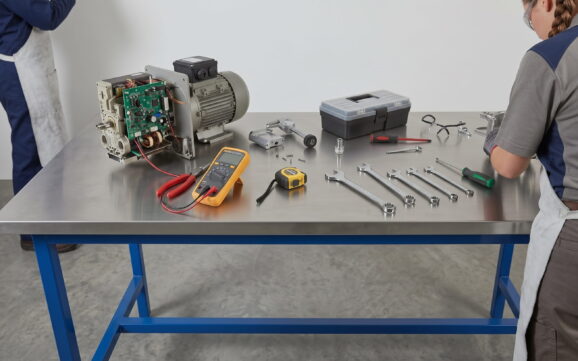
Workbench Worktop Materials Compared: Which One Do You Need?
The worktop is the part of a workbench that actually does the work. The frame holds it up and the accessories organise around it, but every spill, impact, static charge, and hour of use happens at the surface itself. Choosing the wrong one is not a small mistake. It is the difference between a bench […]
View Case Study
Choosing a Lab Bench for Microscopy and Vibration-Sensitive Work
A microscope does not care whether the vibration reaching it came from the floor, from footsteps in the corridor, or from an air handling unit two rooms away. It only registers the movement. At high magnification, movement that would be completely unnoticeable to a person standing at the bench is enough to blur an image […]
View Case Study