


A lab bench for regulated environments is not a single specification. GMP, medical device manufacturing, and nuclear research each impose different requirements on the physical bench a technician works at, and treating them as interchangeable creates two problems. Either you overspend on construction your regulator never asked for, or you underspecify and create a genuine gap at inspection.
Most content on compliant lab benches collapses these requirements into one generic checklist. Stainless steel, easy to clean, meets GMP. That works as a starting point, but it does not hold up once you look closely at what each regulatory framework actually requires from the physical environment, not just the instruments in it.
Why “compliant” isn’t a single specification
Three regulatory contexts sit behind most calls for a “compliant” lab bench, and each one asks something different. Pharmaceutical and life sciences labs working to Good Manufacturing Practice need traceability and cleanability above all else. Medical device manufacturers working to ISO 13485 need cleanroom-grade construction that goes further than general GMP cleanability. Nuclear research and testing environments need decontaminable surfaces and material traceability under an entirely separate set of rules.
These aren’t just labelling differences. A worktop material that satisfies a GMP inspector may fall short of cleanroom classification, and a bench built to withstand pharmaceutical cleaning agents may not be rated for the decontamination chemicals used in a radiological environment. Specifying a bench without knowing which of these applies, or assuming they’re all the same problem, is where most furniture buying guides fall short. It’s also where the two most common mistakes happen. Buying general-purpose lab furniture and hoping it satisfies a specific regulator is one. Over-specifying cleanroom or radiological-grade construction for work that never required it is the other. The sections below take each context in turn.
GMP and pharmaceutical labs: traceability and documentation
Labs working under Good Manufacturing Practice, overseen in the UK by the MHRA, need to demonstrate that the physical environment supports consistent, contamination-free work, not just that the instruments are calibrated correctly. In practice, this means the bench itself needs to be part of the traceable record.
A GMP-suitable bench should have a worktop that resists chemical exposure and repeated wipe-down disinfection without degrading, since a worn or porous surface becomes a contamination risk over time. Welded or sealed joints matter more here than in a general lab, because gaps and seams are exactly where residue and contamination collect between cleaning cycles. Stainless steel or compact laminate worktops are common choices for this reason, though the right one depends on what the lab actually handles.
Traceability extends to the bench itself in some GMP contexts, particularly where material certificates or construction records are checked as part of a wider facility audit. A bench that can be specified with documented material sourcing avoids a scramble to produce that information after the fact. Storage and layout matter too. Benches with defined, separated zones for materials, in-process items, and finished product reduce the risk of mix-ups that GMP documentation exists to prevent in the first place.
Medical device manufacturing and cleanroom environments
Medical device manufacturers work to ISO 13485, the quality management standard covering the full lifecycle of a medical device from design through to servicing. Where this differs meaningfully from general GMP cleanability is in cleanroom construction standards, which go a step further than wipe-down disinfection.
A cleanroom-suitable bench typically needs seamless welds rather than bolted joints, since bolts and fasteners create particle traps that a standard GMP environment can tolerate but a cleanroom cannot. Non-porous stainless steel is the common standard here, chosen for its resistance to the disinfectants and, in some cases, sterilisation processes used in device assembly areas. If your work involves autoclaving or similarly aggressive sterilisation methods, worktop material needs to withstand that specific process, not just general chemical exposure.
This is also the point where it’s worth being honest about overspecification. If your work sits within general GMP boundaries and doesn’t require true cleanroom classification, full cleanroom-grade construction adds cost without adding compliance value.
Component traceability is a related but distinct concern under ISO 13485, since design control requirements mean manufacturers often need to demonstrate exactly where and how a device component was assembled. A bench laid out with defined work zones, and fitted with accessories like labelled parts trays or in-line storage, supports that traceability at the point of assembly rather than relying on paperwork completed after the fact.
Nuclear research and radiological control
Nuclear research and testing facilities operate under a different regulatory structure entirely, licensed and inspected by the Office for Nuclear Regulation. The physical environment requirements here centre on radiological control rather than chemical or biological contamination, which changes what the bench needs to do.
Decontaminable surfaces are the starting point, meaning a worktop that can withstand the specific decontamination chemicals and processes used on site without degrading or trapping contamination in surface damage. Material traceability still matters, but the documentation trail relates to radiological safety and containment rather than pharmaceutical batch records.
Facilities working under ONR licensing conditions typically operate to the As Low As Reasonably Practicable principle, which means bench specification decisions, like everything else in a licensed facility, need to demonstrate that contamination and exposure risks have been reduced as far as reasonably possible. A bench with a genuinely decontaminable, damage-resistant surface supports that case in a way a standard laminate worktop, chosen for cost rather than radiological suitability, would not. This is the regulatory context least covered anywhere in general lab furniture guidance, largely because it applies to a much smaller number of facilities, but the underlying principle is the same as the other two. The bench needs to match the specific control regime it sits within, not a generic idea of “lab grade.”
Specifying the right bench for your regulatory context
Once you know which of these contexts applies, whether that’s one of them or a combination, the practical decisions follow. Worktop material should match your actual contamination or chemical exposure profile. Stainless steel suits cleanroom or washdown environments, compact laminate suits general GMP use, and nuclear or radiological work needs material verified against your site’s specific decontamination chemicals.
Joint and frame construction should match your cleanliness requirement, with seamless welded construction reserved for cleanroom-grade needs rather than applied everywhere by default. Layout and accessories deserve the same scrutiny. A bench fitted with defined storage zones, labelled trays, or in-line documentation holders can directly support the traceability requirements of GMP or ISO 13485 work, while a nuclear or radiological setting may need contamination monitoring equipment mounted at the bench itself rather than added as an afterthought.
Because Benchmaster manufactures its own benches, worktop material, frame construction, and accessories can be configured to the regulatory context you actually operate in, rather than choosing between an over-specified cleanroom bench and an under-specified general one. The laboratory workbench is available with stainless steel, compact laminate, and other worktop options, in sizes from 1200mm to 2000mm wide and 600mm to 1200mm deep, with a 500kg UDL as standard. Find out how to choose a lab bench for calibration and testing.
Specifying a lab bench for a regulated environment: a quick checklist
Before specifying a bench for a regulated environment, confirm the following:
– Regulatory context: Which framework applies, GMP, ISO 13485, nuclear licensing conditions, or a combination?
– Worktop material: Does it match your actual contamination, chemical, or decontamination profile, rather than a generic “lab grade” assumption?
– Joint construction: Is seamless welded construction genuinely required, or does your context allow standard joint construction?
– Cleanability: Can the surface withstand your actual cleaning or sterilisation process without degrading over time?
– Traceability: Does the bench and its materials support the documentation trail your regulator expects?
– Overspecification risk: Are you paying for cleanroom or nuclear-grade construction your actual regulatory context doesn’t require?
Working through these points against your specific regulatory context, rather than a generic compliance checklist, is what separates a bench that passes inspection from one that simply looks the part. Get in touch if you have any questions about creating the right workstation for your laboratory.
- Blog
More like this
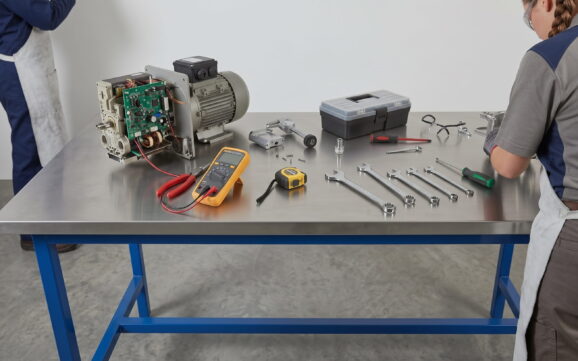
Workbench Worktop Materials Compared: Which One Do You Need?
The worktop is the part of a workbench that actually does the work. The frame holds it up and the accessories organise around it, but every spill, impact, static charge, and hour of use happens at the surface itself. Choosing the wrong one is not a small mistake. It is the difference between a bench […]
View Case Study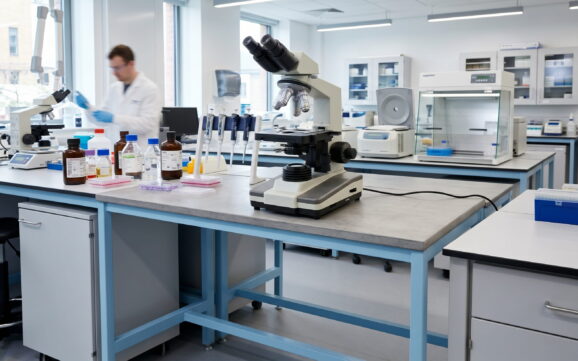
Choosing a Lab Bench for Microscopy and Vibration-Sensitive Work
A microscope does not care whether the vibration reaching it came from the floor, from footsteps in the corridor, or from an air handling unit two rooms away. It only registers the movement. At high magnification, movement that would be completely unnoticeable to a person standing at the bench is enough to blur an image […]
View Case Study
Standard vs Customisable Lab Benches: Why Built to Order Wins for Serious Lab Work
A standard, store-bought lab bench is built to fit nobody’s lab in particular. That is fine for some jobs. For calibration, testing, regulated production, or any work where accuracy and repeatability are the point, a bench built to a generic specification rather than your actual space, equipment, and workflow introduces a variable into the one […]
View Case Study