


A workbench has to carry its load, withstand whatever lands on its worktop and suit the person standing at it every working day. This workbench buyer’s guide covers the decisions that settle all three, from what a bench costs over its working life to how the frame is built, how load capacity is rated, which worktop to choose, and what height, storage and castors to specify.
The right specification depends on the work. A bench for light packing and a bench for pressing bearings in a vice need different frames, tops and load ratings, and the sections below show how to tell them apart.
What Does an Affordable Workbench Cost Over Time?
The purchase price is only one part of what an affordable workbench costs. A low-priced bench can cost more once assembly time, repairs and early replacement are added. Three costs tend to appear after the order is placed.
- Assembly time. Flat-pack benches arrive as parts. Someone has to sort the fasteners, square the legs and tighten the frame before the bench can be used, and that time adds up across a fit-out of several bays.
- Loosening joints. Bolted frames depend on fasteners holding under vibration, vice torque and heavy loads. Over time, bolts can work loose and bolt holes can wear oversize, and the bench begins to rock. Retightening helps for a while but does not remove the cause.
- Early worktop replacement. Low-cost benches often use thin chipboard or MDF tops. Oil, cutting coolant and workshop damp can make these swell and break down, and the top needs replacing long before the frame does.
Where to Keep Costs Down
- Sizes from the published range. Choosing a published size avoids the individual scoping that a fully bespoke bench needs, and it suits most general work envelopes.
- A worktop matched to the task. If the process involves no corrosive chemicals or washdowns, a compact laminate or hardwood top usually costs less than stainless steel and does not affect frame rigidity.
- A fixed height. A fixed height suits a bench used by one person or by people of similar height. Height adjustment pays off where several operators share a station.
Where to Hold the Specification
- The frame. A fully welded steel box-section frame has no structural bolts to loosen and keeps its shape under repeated load.
- The load margin. Rate the bench above your working load, not at it. Dropped tools, hammering and sideways force from vice work all add to the static weight.
[H2] Weight Ratings Explained: Understanding Uniformly Distributed Load (UDL)
Weight ratings are easy to misread. Uniformly distributed load (UDL) describes a load spread evenly across the whole worktop. A bench rated at 1,000 kg UDL is not rated for 1,000 kg landing in one spot, such as a die block set down in the centre.
Choose the tier from the heaviest realistic working load.
- Medium Duty Workbench (500 kg UDL). General garage and workshop use, light assembly, packing lines, basic maintenance and electronics rework, where the weight is spread across the top.
- Heavy Duty Workbench (1,000 kg UDL). Mechanical engineering, toolrooms, component sub-assembly and stations fitted with heavy engineering vices.
- Super Heavy Duty Industrial Workbench (1,500 kg UDL). Heavy tool and die work, engine blocks, hydraulic equipment and steel fabrication.
To size a bench, add the weight of everything it will carry, including the vice, fixtures, tooling and the heaviest workpiece. If a 60 kg vice, 200 kg of tooling and 250 kg of parts are all spread across the top, the static load is 510 kg, which already exceeds the medium duty rating before any impact is considered.
Hammering, pressing and torquing in a vice put dynamic loads through the top and frame that exceed the static weight. Choose a tier with clear headroom above your total.
Worktop Materials: Matching the Surface to the Task
The frame carries the load and the worktop takes the daily wear. Choose the surface by the impact it will take, the chemicals and moisture it will meet, whether static is a concern and how the bench is cleaned. Our guide to workbench worktop materials compared covers each surface in more detail.
Solid Hardwood
Hardwood suits mechanical engineering, toolrooms, maintenance departments and vice-mounted fabrication. It absorbs shock and resists impact. It is gentler on precision metal parts than steel, and a gouged top can be sanded back and resealed on site.
For regular heavy clamping, choose a workbench with vice. It comes pre-drilled for vice installation, with a choice of SG cast iron vices from 4 to 8 inches or an 8 inch Eclipse vice.
Galvanised or Mild Steel
Automotive workshops, heavy fabrication, welding and greasy component stripping all call for steel. It withstands weld spatter, heat and heavy loads, and it wipes clean of oil and grease, although it can scratch more readily than some other surfaces. Galvanising adds a zinc coating for damp bays, while uncoated mild steel will rust if it is left wet. For high heat and sparks, pair it with a dedicated welding bench.
Grade 304 Stainless Steel
Stainless steel suits laboratories, food processing, pharmaceutical production and cleanroom environments where hygiene or washdown rules apply. It is non-porous, resists corrosion and stays stable under most sanitising routines, and the smooth surface wipes down easily. Check the chemicals in your cleaning routine against the grade before ordering. Our stainless steel workbench is made from Grade 304 stainless steel and delivered fully welded.
ESD / Anti-Static Laminate
Electronics repair, micro-soldering, PCB assembly and sensor calibration need an ESD surface, which carries static charge safely to earth and protects sensitive semiconductors. Benchmaster’s ESD ready workbench meets EN 61340-5-1, with earthing points and a static-dissipative top built into the frame. The standard covers the whole ESD protected area, including flooring, wrist straps and handling procedures, so the bench is one part of the system.
Laboratory and Cleanroom Worktops (Trespa TopLab and Chemical Laminates)
Analytical laboratories, pharmaceutical testing and calibration need a flat, chemical-resistant top. Solid phenolic resin surfaces such as Trespa TopLab resist staining, moisture and many solvents, acids and biological agents. Check your specific reagents against the manufacturer’s chemical resistance data.
For labs working to ISO/IEC 17025, see choosing a lab bench for calibration and testing. For microscopy, mass balances and dimensional work, where bench movement can affect readings, see choosing a lab bench for microscopy and vibration-sensitive work. A bench frame is not a vibration isolation system, so follow the instrument maker’s mounting guidance for very sensitive instruments.
Compact Laminate / Melamine
Dispatch lines, dry assembly, inspection desks and dedicated packing benches are well served by compact laminate or melamine. Both are smooth, economical and easy to wipe, but not suited to heavy impact, hot tooling or repeated solvent exposure.
Dimensions, Height and Ergonomic Posture
Ergonomic problems at a workbench usually build up from sustained awkward posture, such as leaning forward to reach across an eight-hour shift, rather than from a single event. The HSE identifies awkward posture and repetitive work as risk factors for work-related musculoskeletal disorders.
- Standing height (840 mm). The height Benchmaster workbenches are built to, and a common working height for general manual assembly, packaging and sorting. The height can be adjusted for a small additional cost.
- Seated height (around 750 mm). Suits microscope inspection, fine component assembly and seated testing. Match it to the operator and the chair.
- Height Adjustable Workbenches. Suit multi-shift stations shared by people of different heights, and work that alternates between seated detail and standing effort. Options include manual pin adjustment and powered electric actuators.
Common bench depths are 600 mm, 750 mm and 900 mm. A deeper top gives more space but puts the back of the bench beyond comfortable reach. Keep regularly used parts near the front or in rear storage the operator can reach without stretching. Our guide to ergonomic workbench heights explains how to match the height to the operator.
Storage and Workflow Accessories
A workbench should organise the process around it and save floor space. Workbench accessories fitted to the welded frame keep the work area clear.
- Rear support posts and louvre panels hold plastic parts bins within easy reach.
- Perforated steel backboards take hooks for tool shadow-boarding and visual 5S organisation.
- Overhead LED task lighting reduces shadows over fine assembly without lamps on the worktop.
- Under-bench storage comes as single drawers, multi-drawer tool chests or lockable cupboards built into the frame.
- Integrated electrical trunking keeps cables off the worktop and away from spills.
Static vs Mobile: When Do You Need Wheels?
Static benches give the highest rigidity and load ratings. Flexible production lines, lean manufacturing cells and maintenance hangars often need a mobile workbench or a dedicated mobile packing bench instead. When specifying a mobile bench, check two things.
- Castor rating. The frame rating does not set the safe working capacity on its own. The castors do. A frame rated at 1,000 kg UDL still needs heavy-duty industrial swivel castors whose combined rating covers your working load.
- Total-stop locks. These lock both wheel rotation and swivel and keep the bench in place during work.

Workbench Buyers Guide Checklist: What to Confirm Before You Order
Before requesting a quotation, work through these points.
- What is the maximum working load? Add equipment, tooling, parts and impact loads to choose between medium duty (500 kg UDL), heavy duty (1,000 kg UDL) and super heavy duty (1,500 kg UDL).
- What will touch the worktop? Lubricants, heat, chemical washdowns, impact or ESD sensitivity.
- Is the station seated, standing or shared? The answer decides between a seated height of around 750 mm, a standing height of 840 mm and a height adjustable frame.
- What storage and services need mounting? Power trunking, tool boards, drawers or overhead lighting.
- Is the delivery route clear? A welded bench arrives complete. Check doorway widths, stairwells and corners before delivery.
Built to Order, With Bespoke Where You Need It
A store-bought bench is made in volume to a fixed size, so the operator and the room have to adapt to it. Every Benchmaster workbench is built to order in the UK, with the size, worktop and storage chosen to suit the work.
Where a layout needs something outside the published options, such as an awkward room footprint, a pillar cut-out or a specific production flow, bespoke installations are scoped and quoted individually so the bench fits the room rather than the other way round. For laboratory work, see our laboratory bench page.
Need help specifying a workbench for your facility? Call our technical team on 01457 837146 or get in touch to talk through load ratings, sizing and installation.
- Blog
More like this
Electric vs Manual Height Adjustable Workbenches: How to Choose
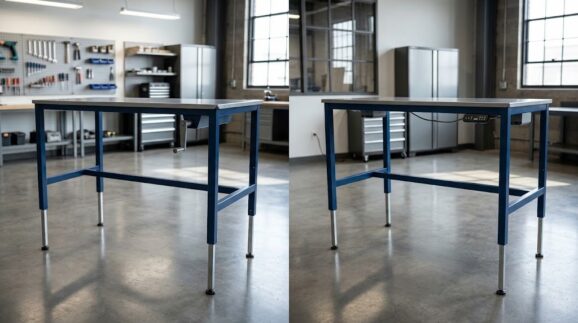
Electric and manual height adjustable workbenches from Benchmaster are both hydraulic and built on the medium duty range. The difference is how the hydraulic pump is driven. The electric version uses a motor unit and a push button, and the manual version uses a removable hand crank. Both are available at 300kg or 600kg UDL, […]
View Case Study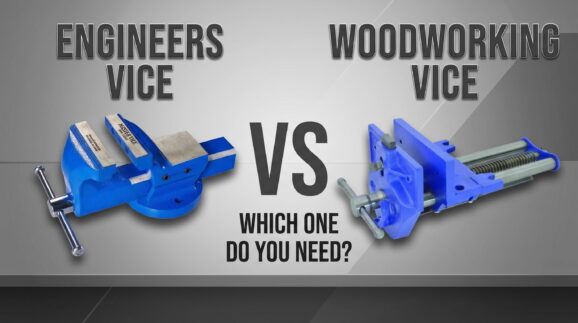
Engineers Vice vs Woodworking Vice: How to Choose
An engineers vice grips metal with hardened, serrated steel jaws and takes the force of filing, sawing and hammering. A woodworking vice holds timber between smooth, usually wood-lined jaws that leave the surface unmarked. The choice between an engineers vice and a woodworking vice depends on the material you hold and the force you put […]
View Case Study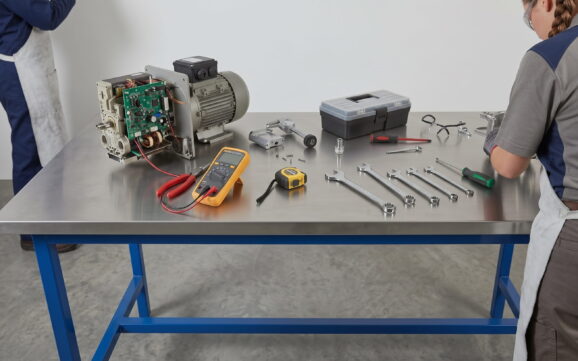
Workbench Worktop Materials Compared: Which One Do You Need?
The worktop is the part of a workbench that actually does the work. The frame holds it up and the accessories organise around it, but every spill, impact, static charge, and hour of use happens at the surface itself. Choosing the wrong one is not a small mistake. It is the difference between a bench […]
View Case Study