


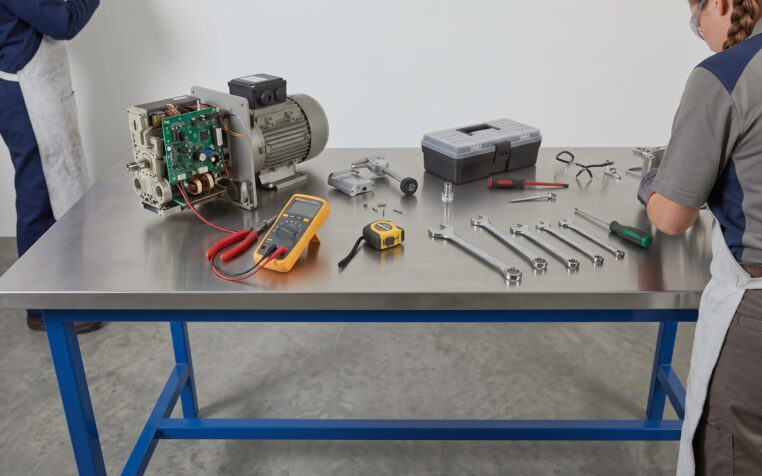
The worktop is the part of a workbench that actually does the work. The frame holds it up and the accessories organise around it, but every spill, impact, static charge, and hour of use happens at the surface itself. Choosing the wrong one is not a small mistake. It is the difference between a bench that lasts and one that needs replacing, or worked around with mats, covers, and workarounds, within a year or two of buying it.
Benchmaster benches are available with MDF, melamine laminate, laminate, compact laminate, galvanised steel, stainless steel, ESD anti-static, and black rubber on steel worktops, each with genuinely different strengths rather than being interchangeable versions of the same idea. This article covers what each is actually suited to, so you can match the material to your work rather than defaulting to whatever seems most familiar.
Dry, general-purpose work: MDF, melamine laminate, and laminate
MDF is the most affordable option, and it earns that price with genuine limitations. It is easy to work with and holds up well to general dry use, light assembly, and packing tasks, but it has little resistance to moisture. Left wet, it swells and softens, so it belongs in dry environments only, and it is not the right choice anywhere near a sink, a coolant line, or regular spillage of any kind.
Melamine laminate takes that same MDF core and faces it with a durable, easy-to-clean surface, which removes some of MDF’s weaknesses while keeping the cost relatively low. It resists light spills and general wear better than uncoated MDF, without the cost of a full laminate or compact laminate worktop, which makes it a common choice for education settings, packing stations, and general assembly work where the budget matters but a bare MDF surface would not last.
Laminate, and compact laminate in particular, goes further again. It is denser and more resistant to impact, heat, and chemical exposure than melamine laminate, which makes it a better fit for general workshop use where the bench will see more than light assembly. Compact laminate in particular holds up to years of daily use without the surface wearing through the way a thinner laminate eventually can, which is why it tends to appear on benches that see continuous use across a working day rather than occasional light tasks. This is the material behind our Trespa bench. For the full detail on how melamine and laminate actually differ, What is the Difference Between Melamine and Laminate covers it properly rather than repeating that comparison here.
Heavy impact and workshop use: galvanised steel and black rubber on steel
Where the work involves real physical abuse, dropped tools, hammering, heavy components dragged across the surface, wood and laminate worktops start to show it, first as surface damage and eventually as a worktop that no longer sits flat or clean. Galvanised steel handles this kind of use without denting or splitting the way a softer material would, and its zinc coating gives it a genuine degree of corrosion resistance, which matters in workshops where oil, coolant, or general moisture are a fact of daily use rather than an occasional spill. It’s the standard top on our Heavy Duty Workbench for exactly that reason.
Black rubber on steel takes a different approach to the same problem. Rather than just resisting impact, the rubber surface absorbs it, which reduces both the damage to whatever is dropped and the noise of the impact itself, a genuine consideration in a busy workshop running multiple benches close together. It is a common choice for metalworking and assembly work where tools and components are handled roughly as a matter of course, and where protecting delicate components from a hard landing matters as much as protecting the bench itself, which is why it appears as an option on our Welding Bench.
Worktop material is only half of what matters for this kind of use. How much weight the bench itself is rated to carry matters just as much, and How Much Weight Can a Workbench Hold covers that side of the specification in detail. Our Super Heavy Duty Workbench combines a galvanised steel top with a 1500kg load rating, a common pairing for exactly this kind of heaviest-duty use.
Hygiene-critical and corrosion-prone environments: stainless steel
Food production, pharmaceutical manufacturing, medical device work, and other hygiene-critical settings need a worktop that can be cleaned thoroughly and repeatedly without degrading, and that resists corrosion from cleaning chemicals or the materials being handled. Stainless steel is the standard answer to that requirement, and for good reason. It has no porous surface for contamination to lodge in, it tolerates aggressive cleaning regimes, and it holds up to corrosive exposure that would damage most other worktop materials over time.
This is also often a regulatory rather than purely practical decision, since many hygiene-critical settings specify stainless steel or an equivalent material as part of their compliance requirements. Our Stainless Steel Workbench uses grade 304 stainless steel with closed corners rather than exposed seams, which removes the joints where contamination would otherwise collect. It supports a 400kg uniformly distributed load on a 40mm x 40mm box section frame, and the worktop is normally welded in place for hygiene reasons, though it can be specified as removable where a deep clean underneath is needed periodically.
Static-sensitive electronics work: ESD anti-static worktops
Electronics assembly introduces a different problem entirely. A worktop surface that is otherwise perfectly durable, a compact laminate or even a stainless steel top, can still allow static charge to build up and discharge into sensitive components, damaging or degrading them in ways that are not always immediately visible at the time. That kind of latent damage can pass inspection and still cause a component to fail weeks later in the field, which is what makes it a genuinely costly risk rather than a cosmetic one. An ESD anti-static worktop is designed specifically to dissipate that charge safely rather than let it accumulate in the first place.
Whether you actually need this protection depends on what you are working with, and ESD vs Standard Workbenches: Do You Need an Anti-Static Workspace? walks through that decision directly. If you have already established that you need ESD protection, ESD Workbenches and Safe Electronics Assembly: A Practical Guide covers how to set up the workspace correctly around it. Our ESD Ready Workbench is built to that standard, IEC 61340-5-1.
Caring for your worktop, whichever material you choose
Every material on this list needs different care to actually last as long as it should, and treating them all the same is one of the more common ways a good material choice ends up underperforming. MDF and melamine laminate need to stay dry and away from harsh chemicals. Stainless steel needs cleaning products that will not damage its surface finish or introduce corrosion risk of their own. Galvanised steel holds up to rough treatment but still benefits from being kept free of standing liquid where possible. How to Keep Your Workbench Clean covers the specifics for each material properly, since getting maintenance wrong can undo the benefit of choosing the right worktop in the first place.
How to choose the right material for your setup
Is the environment dry, or exposed to moisture and chemicals?
Dry, general use suits MDF, melamine laminate, or laminate. Wet, oily, or chemically exposed environments call for galvanised steel, stainless steel, or a higher-grade laminate depending on the specifics, since none of the dry-use materials will hold up to sustained exposure without degrading.
Does the work involve heavy impact or dropped tools?
If so, galvanised steel or black rubber on steel will hold up far better than MDF, laminate, or melamine, which are not built to absorb that kind of physical abuse. The choice between the two usually comes down to whether noise reduction matters as much as raw durability.
Is hygiene or corrosion resistance a regulatory requirement?
Food production, pharmaceutical, and medical settings often specify stainless steel or an equivalent for exactly this reason. If your setting has documented material requirements, check them before choosing on preference alone, since the requirement may be more specific than a general sense of “needs to be cleanable.”
Does the work involve static-sensitive electronic components?
If so, an ESD anti-static worktop is not optional. None of the other materials on this list offers that protection, regardless of how durable or well suited they are otherwise, and the cost of a component failure downstream will usually outweigh whatever was saved by skipping it.
Talk to a manufacturer who builds to your specification
Worktop material is one of the options you choose when ordering a Benchmaster workbench, whatever industry or environment it is going into. If your setup needs a material or finish outside what is listed, whether that is a specific chemical resistance requirement or an unusual combination of properties, contact our team and we will scope it as a fully bespoke build.
- Blog
More like this

Choosing a Lab Bench for Microscopy and Vibration-Sensitive Work
A microscope does not care whether the vibration reaching it came from the floor, from footsteps in the corridor, or from an air handling unit two rooms away. It only registers the movement. At high magnification, movement that would be completely unnoticeable to a person standing at the bench is enough to blur an image […]
View Case Study
Standard vs Customisable Lab Benches: Why Built to Order Wins for Serious Lab Work
A standard, store-bought lab bench is built to fit nobody’s lab in particular. That is fine for some jobs. For calibration, testing, regulated production, or any work where accuracy and repeatability are the point, a bench built to a generic specification rather than your actual space, equipment, and workflow introduces a variable into the one […]
View Case Study
Lab Benches for Regulated Environments: Traceability, Cleanability and Compliance
A lab bench for regulated environments is not a single specification. GMP, medical device manufacturing, and nuclear research each impose different requirements on the physical bench a technician works at, and treating them as interchangeable creates two problems. Either you overspend on construction your regulator never asked for, or you underspecify and create a genuine […]
View Case Study