


Melamine and laminate are often mistaken for being the same, with many being unaware of the distinctions between the two. It is very common for those in need of a melamine board for their counter or tabletop to mistakenly think they require laminate.
Melamine vs Laminate – The Differences
Fundamentally, melamine and laminate differ in their manufacture and the level of pressure applied during the manufacturing process. Melamine is made by fusing a single layer of resin onto an MDF core with low pressure, while laminate is created by bonding multiple layers of kraft paper under high heat and pressure. These processes lead Laminate to be far more durable and tough than melamine.
What are Melamine and Laminate Used For?
Both melamine and laminate are common staples in workbenches, as they are used to apply a user-friendly finish to countertops, workbenches, work surfaces and walls. However, due to their differing properties, they are used within different roles to one another.
- Melamine is most commonly used in areas where there are limited impacts with large forces, as Melamine is somewhat malleable and liable to damage, warping or breaking when placed under stress. This includes internal shelving, office furniture and vertical surfaces.
- Laminate is contrarily used in roles where durability and resistance to forces is required, such as frequently-used work surfaces, flooring and workbench tops.
Do I Need a Laminate Bench or a Melamine Bench?
Choosing between a Laminate bench and a Melamine bench is most commonly decided by balancing budget and durability:
Melamine Benches suit applications where it is unlikely that there will be scenarios with high impact, which could damage or break the bench. Therefore, melamine benches should be used when seeking a professional aesthetic, but with a low likelihood of high stress.
Laminate Benches should be used for areas where high-impact and high stress is anticipated, as their durability lends to situations where damage resistance is required.
Benchmaster’s DIY Workbench – The Perfect Laminated Workbench
When searching for a durable and reliable workbench for your space, Benchmaster’s DIY Workbench is the ideal solution. With an impact-resistant worktop, our DIY Workbench utilises the benefits of laminate to create a work-station with robust capabilities, allowing users to complete project work seamlessly.
For more information on our range of Workbenches, please get in touch with us today.
Take a look at our Buyer’s Guide to Finding the Best Affordable Workbench for more help when choosing your next workbench.
Melamine vs Laminate FAQs
Can Melamine benches and laminate benches be painted?
Both Melamine and Laminate can be painted, however standard paint will not stick as both surfaces are non-porous. Therefore, a bonding primer designed for laminates should first be applied, followed by an enamel topcoat.
How do I clean my Melamine Bench or Laminate Bench?
For everyday cleaning, use a soft microfiber cloth with warm water and a mild soap, to wipe down the surface of your laminate bench top. Once complete, use a towel to dry the surface, especially near joints with the MDF board, as allowing water to sit and seep into the wood can cause it to swell
- Blog
More like this
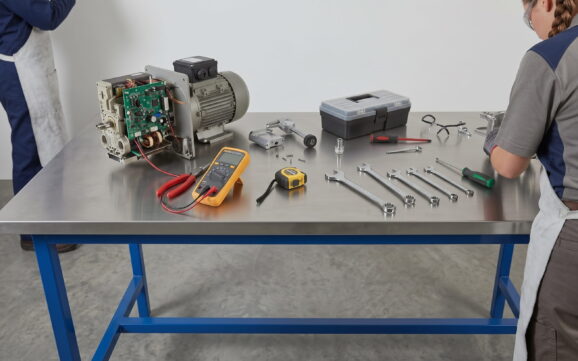
Workbench Worktop Materials Compared: Which One Do You Need?
The worktop is the part of a workbench that actually does the work. The frame holds it up and the accessories organise around it, but every spill, impact, static charge, and hour of use happens at the surface itself. Choosing the wrong one is not a small mistake. It is the difference between a bench […]
View Case Study
Choosing a Lab Bench for Microscopy and Vibration-Sensitive Work
A microscope does not care whether the vibration reaching it came from the floor, from footsteps in the corridor, or from an air handling unit two rooms away. It only registers the movement. At high magnification, movement that would be completely unnoticeable to a person standing at the bench is enough to blur an image […]
View Case Study
Standard vs Customisable Lab Benches: Why Built to Order Wins for Serious Lab Work
A standard, store-bought lab bench is built to fit nobody’s lab in particular. That is fine for some jobs. For calibration, testing, regulated production, or any work where accuracy and repeatability are the point, a bench built to a generic specification rather than your actual space, equipment, and workflow introduces a variable into the one […]
View Case Study